

When you manage a fleet of electric sightseeing vehicles or are planning to purchase new ones, a core question arises: which type of battery should you choose? This decision directly impacts your fleet’s operating costs, efficiency, and user experience.
Currently, the market is dominated by two main technological camps: Lithium batteries and Lead-Acid batteries (primarily Valve-Regulated Lead-Acid, VRLA). They are like two “energy partners” with distinctly different personalities, each with its own merits. As Olivia Vehicle Company with 12 years of experience in electric vehicle R&D, we will provide you with an in-depth yet easy-to-understand analysis to help you make the best decision.
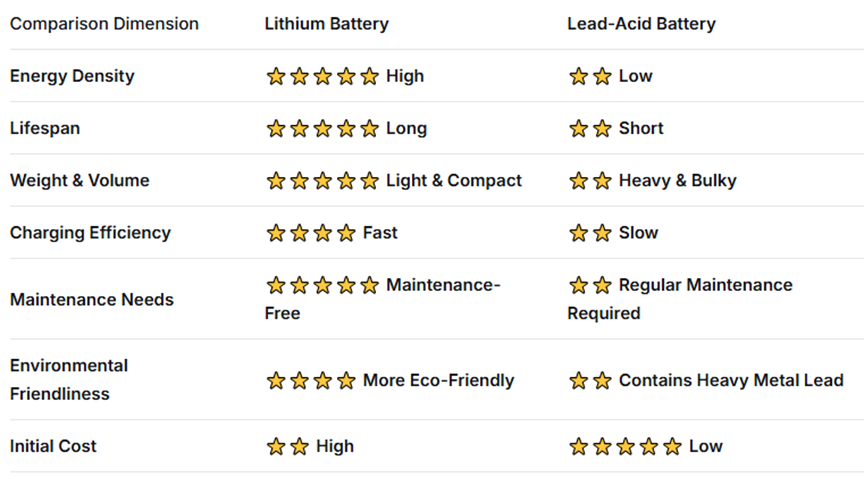
1. Head-to-Head: Core Performance Comparison To give you a clear overview, let’s start with a table highlighting their key differences:
2. Deeper Dive: What Do These Differences Really Mean?
Now, let’s explore what these differences mean in practical operations:
Range & Power: It’s All About Energy Density
Lithium batteries have a very high energy density. This means that for the same weight and size, they can store more power. This translates directly to longer range per charge and more powerful performance, especially noticeable when climbing hills or under heavy loads.
Lead-Acid batteries have low energy density. To achieve a similar range, the battery pack is often heavier and larger, inadvertently increasing the vehicle’s weight, which in turn consumes some of the energy.
Total Cost of Ownership: Visible vs. Hidden Expenses
The initial purchase price of a Lithium battery is typically 2-3 times that of a lead-acid battery, which can be a deterrent. However, its cycle life is extremely long, generally reaching 2000+ cycles, which is 3-5 times that of lead-acid batteries (around 300-500 cycles). This means that over the entire lifespan of the sightseeing vehicle, you might only need one set of lithium batteries, compared to needing to replace 3-4 sets of lead-acid batteries. In the long run, the total cost of ownership for lithium batteries is often lower.
Lead-Acid batteries, while “cheap to buy,” incur ongoing costs through frequent replacements and higher electricity bills (due to lower charging efficiency and higher self-discharge), continuously eating into your budget.
Operational Efficiency: Time is Money
Lithium batteries support fast charging, often fully charging in 2-4 hours. This allows for topping up the charge during short breaks in tourist schedules, enabling high-efficiency operation where “the vehicle never stops.”
Lead-Acid batteries charge slowly, typically requiring 8-10 hours. This basically means charging overnight and using during the day, limiting vehicle utilization.
Maintenance & Convenience: Hassle-Free is Key
Lithium batteries are truly maintenance-free. There is no need to add electrolyte, no memory effect, and they can be charged at any time, significantly reducing labor costs.
Lead-Acid batteries require regular checking and topping up with distilled water. They are also recommended to be fully charged promptly after each use, otherwise, their lifespan will be severely affected. Maintenance is more cumbersome.
Safety & Environmental Impact: A Social Responsibility
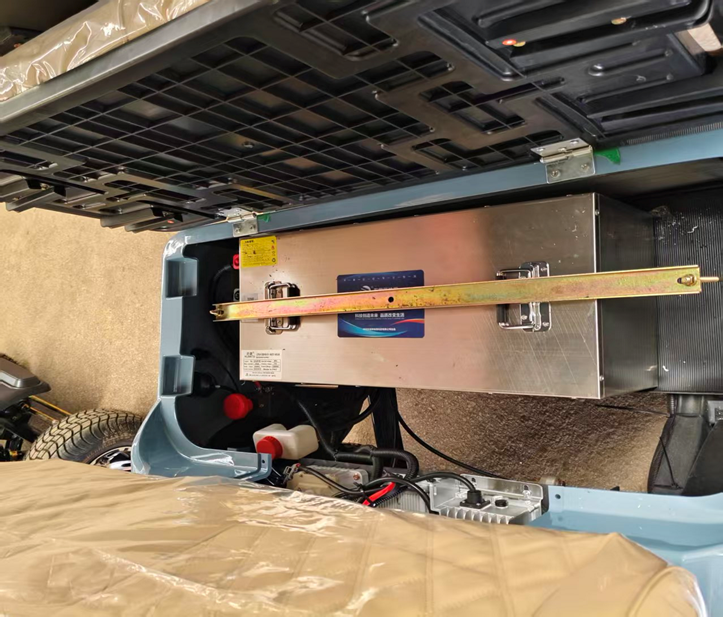
Both are safe when used correctly. However, lithium batteries are more sensitive to overcharging, over-discharging, and short circuits. They require an excellent Battery Management System (BMS) for protection. Olivia’s lithium battery packs all use automotive-grade BMS for comprehensive protection.
Lead-Acid batteries contain sulfuric acid and lead. If handled improperly, there is a risk of leakage. If not recycled properly after disposal, they can cause serious environmental pollution.
3. Scenario-Based Choice: Which One is Right for You?
Understanding the performance is one thing; applying it to your real-world situation is what matters.
🏞️ Choose 【Lithium Batteries】 if your scenario is:
High-Frequency, High-Intensity Operations: Such as large scenic spots, theme parks where vehicles need to run for long hours under heavy load, with hard requirements for range and charging speed.
Hilly Terrain: The operating area has many slopes, requiring vehicles to provide sustained, powerful torque.
Pursuing Premium Experience: Wanting lighter vehicles, less noise, enhancing tourist comfort, and projecting a modern, eco-friendly, high-tech company image.
Long-Term Budget Focus: Willing to invest more upfront for lower comprehensive costs and more hassle-free management in the long run.
🌅 Choose 【Lead-Acid Batteries】 if your scenario is:
Low-Frequency, Short-Distance Operations: Such as small communities, internal factory shuttles, with fixed and short daily mileage, and sufficient time for overnight charging.
Strictly Limited Initial Budget: The upfront purchase cost is the primary concern, needing to control immediate cash outflow.
Maintenance Capability Available: Has dedicated maintenance staff who can perform regular battery upkeep and checks.